

What actually works, what does not, and what you can realistically protect
If you live in Kloof, Hillcrest, Westville, Durban North, La Lucia, Glenashley or almost anywhere along the North Coast, vervet monkeys are part of daily life. They open bins, strip vegetable gardens, raid kitchens through open windows and undo a season of growing in an afternoon. Monkey proofing in Durban is a common requests, and it is worth being honest about what is achievable before you spend money on it.
Why monkey proofing in Durban is a genuine requirement
This is not a minor nuisance in a few suburbs. Urban vervet populations along Durban’s coastal belt are estimated to sit far above what the remaining coastal forest could naturally support, concentrated in exactly the leafy residential areas people want to live in. Development has removed natural habitats while gardens, bins and fruit trees, and even kitchens, have replaced it with an easier food supply.
It is also worth stating plainly: harming monkeys is illegal under the Animals Protection Act, and can lead to cruelty charges. Any approach worth considering is a deterrent or an exclusion approach. The Durban and Coast SPCA publishes practical guidance on coexisting with them, and Ezemvelo KZN Wildlife is the provincial conservation authority.
What monkey proofing in Durban can and cannot achieve
As you may well be aware, you cannot monkey-proof an open garden. Vervets climb better than any fence you can build, they use overhanging branches, roofs, walls and power lines as highways, and a boundary fence simply becomes something they sit on.
What you can do – and do effectively – is enclose specific areas. A vegetable patch, a nursery section, a seedling area, a bin store, a washing line, a koi pond, a carport. Targeted enclosure works. Whole-property exclusion does not.
Approaching it that way changes the economics completely. Screening a six-metre-square vegetable garden properly costs a fraction of fencing a boundary, and it actually solves the problem.

Shadecloth screening: the practical starting point
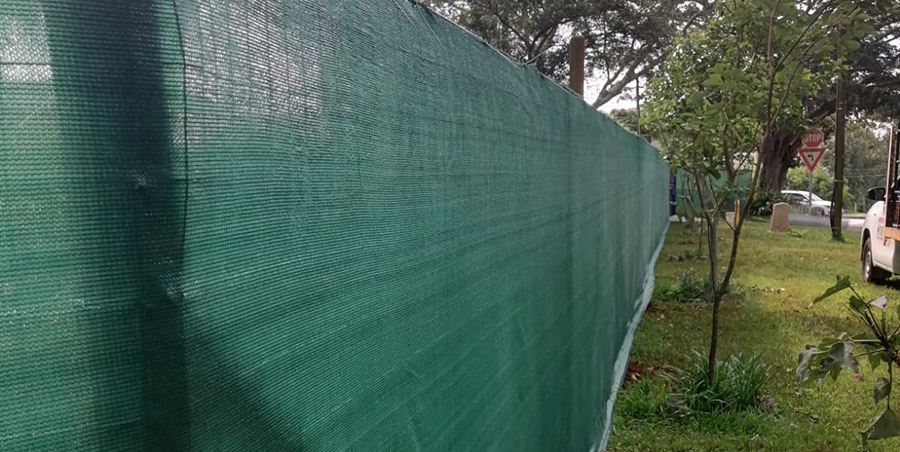
The material we most often recommend for this is shade cloth. We stock it at 80% shade factor, 1.8m high in dark green, sold by the metre and cut to length.
It works for this purpose for a few reasons. It is a visual barrier as well as a physical one, so an enclosed area stops advertising what is inside it. It is inexpensive enough to enclose a decent-sized area without a large outlay. And it doubles as sun protection, which for a vegetable garden or nursery bed is useful in its own right.
For a growing area, the usual approach is a timber frame with shadecloth on the sides and over the top. The roof matters as much as the sides – anything left open above is simply an entrance. Our guide to shadecloth covers shade factors, spans and fixing in more detail.
Weldmesh where you need to see through
Where visibility matters, or where you need a more rigid barrier, weldmesh is the alternative. We stock rectangular weldmesh at 1.8m high with a 50x100mm aperture, in 30m rolls, and can cut it down to lengths as short as 10m.
It is commonly used around smallholdings, construction sites and gardens where you want a security barrier you can still see through. Two practical points specific to this region:
- Use fully galvanised weldmesh. The corrosion factor along this coast is high, and non-galvanised mesh will not last.
- Tie wire matters. Mesh is only as secure as its fixings, and loose mesh gets pushed aside.
Full specifications are on our weldmesh fencing page.
Getting the supporting structure right
Whichever material you choose, it hangs on poles, and poles are where these projects can fail. Our recommended practice for weldmesh and screening structures is specific:
- Poles shouldn’t be too far apart. Wider spacing lets the mesh or cloth sag, and sag is what animals exploit.
- Buried at least 600mm deep for stability.
- Do not concrete the bottom of the pole. Moisture needs to drain back into the soil rather than sit in a concrete cup, which is what rots poles from the base up.
- Get in touch with us for more assistance.
Use CCA-treated poles treated for ground contact. An under-treated pole in Durban soil will fail long before the mesh does – our guide to H4 treated poles explains why that specification matters.
Things worth doing that cost nothing
Physical screening works best alongside removing the incentive:
- Secure bins with tight-fitting lids, or put the bin inside an enclosure
- Keep food out of sight of open windows and off visible counters
- Pick fruit rather than letting it fall and ferment
- Trim branches that overhang a roof or an enclosed area – most access comes from above
- Never feed them, including indirectly through pet food left outside
The SPCA also notes that vervets are naturally wary of snakes, and that realistic rubber snakes moved periodically can act as a deterrent. Treat that as a supplement to exclusion, not a replacement for it.
What we supply for monkey proofing in Durban
We are a timber and fencing supplier rather than a wildlife service, so what we provide is the material side: shade cloth cut to length, galvanised weldmesh, tie wire, treated poles, fixings and, where requried, installation. Between those, most targeted enclosure projects are straightforward.
If you can describe the area you want to protect and roughly its dimensions, we can work out materials and quantities quickly. Contact Durban Poles and we will help you protect the part of your garden that actually needs it.
Planning a fencing project?
From picket fencing and garden edging to post and rail, we supply DIY materials and handle full installations across KwaZulu-Natal. All our timber is SABS and ISO 9001 approved.