

Timber courses built for schools, estates, fitness groups and gardens across Durban
When most people picture an obstacle course, they picture children scrambling over a cargo net at a school fun day. That is one version of it. But across Durban and the wider KwaZulu-Natal region, obstacle courses in Durban are increasingly being built for estates, crèches, training facilities and adults who would rather train outdoors than pay a monthly gym fee.
If you are weighing up a course for a school, an estate common area, or your own garden, this guide covers what these structures involve, who they suit, and what to think about before committing to a layout.
What timber obstacle courses in Durban actually involve
An obstacle course is a sequence of individual elements arranged so that users move continuously from one challenge to the next. Unlike a wooden jungle gym, which is usually a single connected structure, a course is modular by nature. It can follow a straight line down the edge of a field, wrap around existing trees, or loop back on itself in a compact garden.
Typical timber elements include:
- Balancing beams for coordination and core stability
- Swing rope bridges that challenge balance under movement
- Horizontal cargo nets for climbing, crawling and upper body strength
- Over and under frames that train speed, agility and flexibility
- Bridges that go up, through and down, adding vertical variation
- Tyre balance obstacles for stepping accuracy and rhythm
- Steel drums, which can form tunnels or connect into a jungle gym platform
Because each element is separate, a course can be built in stages. That matters more than it sounds, and we will come back to it. Our obstacle course range shows the individual elements in more detail.
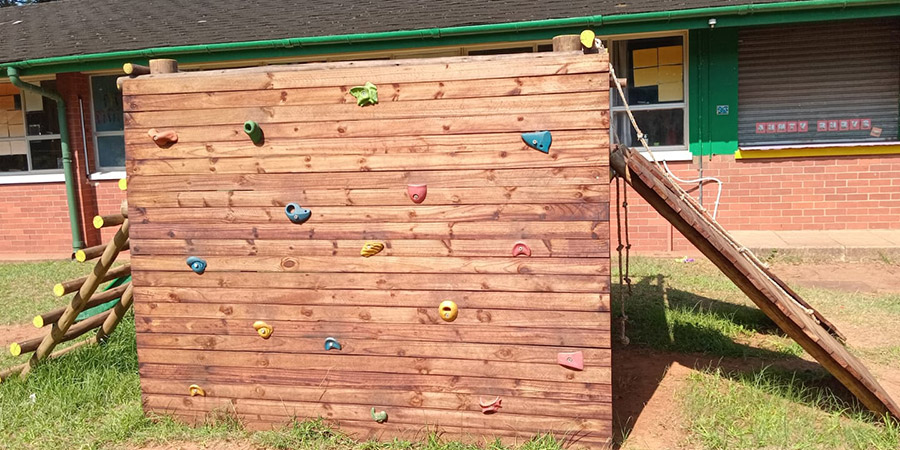
Obstacle courses in Durban for schools and crèches
For early childhood development centres and primary schools, an obstacle course does something a flat playground cannot. Climbing, balancing and crawling develop gross motor skills, spatial awareness and proprioception, which is a child’s sense of where their body is in space. These are the same physical foundations that later support concentration and classroom readiness.
A course also solves a practical problem for schools: throughput. A single swing set serves one child at a time. A course with six or seven elements keeps a whole class moving simultaneously, which is why they work so well during PE periods and break times.
When planning for a school, the age range matters most. A course built for Grade R will bore a Grade 6 class, and a course built for seniors will be unsafe for the little ones. Where a school serves a wide age spread, the usual solution is either two shorter courses at different heights, or a single course with elements that can be bypassed.
Obstacle courses for Durban estates and body corporates
Residential estates across the greater Durban area are competing on lifestyle amenities, and outdoor play areas are consistently near the top of what young families look for. An obstacle course occupies ground that is often otherwise unused, such as the strip alongside a green belt or the area behind a clubhouse.
There are a few considerations specific to shared spaces. Sightlines matter, because parents want to supervise from a bench or a patio rather than walking the course. Durability matters more than in a private garden, since an estate course may see a hundred children a week rather than three. And the layout should account for how people naturally move through the space, so the course does not cut across an established walking route.
Outdoor adult gyms and fitness training
This is the segment most people do not realise exists. The same treated timber structures that work for children can be built at adult scale and load ratings, which opens up several uses:
- Pull-up bars, built as a timber structure with purpose-made rubber climbing grips
- Push-up bars, made to your specified height and spacing
- Adult monkey bars, either standalone or attached to a larger platform
Bootcamp and functional fitness operators use these for circuit training. Estates install them alongside walking trails. Some homeowners simply want a pull-up bar that will not rust, does not need a subscription, and looks like part of the garden rather than gym equipment dumped on a lawn.
The advantage of timber over steel outdoor equipment in a coastal climate is straightforward: correctly treated timber does not corrode. In an environment with salt air and high humidity, that is not a small consideration.
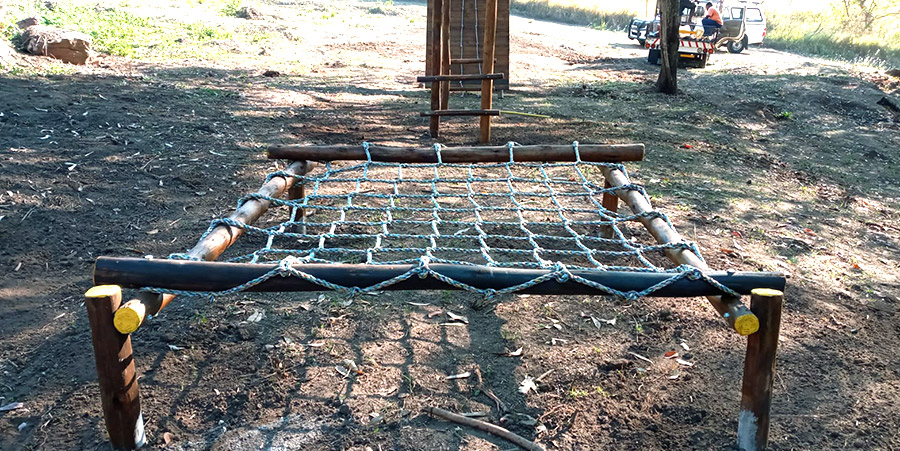
What to plan before building obstacle courses in Durban
Space and layout. A course needs more room than the elements themselves occupy. You need clearance around each obstacle for safe falls and for users queuing or passing. A compact garden can still take a course, but the layout will be shaped by what is already there.
Ground conditions. Slope, drainage and soil type all affect how structures are anchored. KwaZulu-Natal has plenty of steep, clay-heavy sites, and uneven ground is normal rather than exceptional. It is workable, but it needs to be assessed rather than assumed.
Age range and ability. Decide who the course is genuinely for before choosing elements. A course that tries to serve toddlers and adults equally usually serves neither well.
Materials. Outdoor structures in this climate need to be built from properly treated timber. We use SABS-approved, CCA-treated timber poles for obstacle courses, preservative-treated to handle constant outdoor exposure and frequent use without degrading.
Build it in stages if you need to
One of the practical advantages of a modular course is that it does not have to be built all at once. Elements can be fitted separately or in totality, which means a school can install four obstacles this year and add three more next year as budget allows. For families, it means a course can grow as children do.
This tends to suit organisations working from an annual budget far better than a single large capital outlay, and it means the course is never mismatched to the age group using it.
Getting an obstacle course specified and quoted
Because every site is different, courses are quoted after a survey rather than from a catalogue. We survey the area, confirm your requirements, and then size the elements to suit the space and the age group. If you have ideas of your own, or an element you have seen elsewhere that is not in our standard range, it is worth asking. Custom builds are normal in this work rather than exceptional.
Durban Poles has been designing and building timber play and fitness structures for over two decades, for schools, playgrounds, training facilities and private gardens. Our gallery shows previous builds, and the jungle gym FAQs answer many of the questions that come up around installation, ground preparation and maintenance.
If you are considering an obstacle course or an outdoor adult gym, the most useful first step is a conversation about your space, who will use it, and what you want them to get out of it. Contact Durban Poles and we will advise on layout, elements and staging.
Thinking about an obstacle course?
We design and build custom timber obstacle courses and outdoor adult gyms for schools, estates, training facilities and gardens in and around Durban. All our timber is SABS and ISO 9001 approved.