
What the treatment classes mean, and how to check what you are actually buying
Ask three timber suppliers for fencing poles and you may get three different products, all described as “treated”. The difference between them is not marketing language. It is a formal specification, it is defined by South African national standards, and getting it wrong is the single most common reason a timber structure fails years before it should. H4 treated poles are the class most outdoor projects actually need, and this guide explains why.
What hazard classes mean for H4 treated poles
In South Africa, preservative-treated timber is classified by hazard class, written as H2, H3, H4 and so on. The class describes the conditions the timber will face in service, not the type of timber itself.
The classes are defined in SANS 10005, with minimum treatment requirements set out in SANS 1288. The South African Wood Preservers Association publishes a guidance note on understanding hazard classes that sets out how they are applied. The higher the number, the more hostile the environment and the more preservative retention the timber requires.
The logic is simple. Timber that sits indoors faces insects. Timber outdoors above ground faces weather as well. Timber buried in soil faces constant moisture, fungal decay and termites simultaneously, and needs far more protection.

The treatment classes explained
H2 – internal, protected from wetting
For timber that stays dry and indoors. The hazards are borers and termites rather than decay. Typical uses are roof trusses, framing, interior joinery, flooring and furniture. H2 timber has no business being outdoors. If it gets wet repeatedly, it will fail.
H3 – external, above ground
For timber exposed to periodic wetting but not in contact with soil. Hazards are moderate decay, borers and termites. Typical uses are weatherboards, fascias, pergola rafters, and the above-ground components of fencing and playground structures.
This is the class people most often get wrong. H3 is genuinely outdoor timber, which makes it tempting. But the moment any part of it enters the ground, H3 is no longer adequate.
H4 treated poles – in-ground contact
For timber in normal ground contact, where wetting and leaching are constant and the hazards are severe decay, borers and termites. Typical uses are fence poles, landscaping timbers and playground structures.
This is the class that matters most for anyone building a fence, a jungle gym or an outdoor structure standing in soil. It is also what we treat all our timber poles to, in line with SAWPA standards.
H5 – fresh water and wet soils
A step beyond H4, for permanently wet conditions or structurally critical in-ground applications. SAWPA guidance associates H5 with piling and foundation poles, agricultural and feedlot posts, retaining walls, culverts, jetties and slipways.
If your project involves permanent immersion, a retaining structure holding back a load, or foundation piling for a building, do not assume H4 will do. Ask specifically, and specify in writing.
The line that matters most: above ground or in ground
If you remember one thing, remember this. The jump from H3 to H4 is not incremental. Soil holds moisture against timber permanently, and it is where fungal decay and termites do their work. Timber that would last fifteen years above ground can fail in three when buried, if it was never treated for ground contact.
This is why a fence can rot at the base while the rails above look almost new. The failure point is always where the pole meets the soil.

How to check H4 treated poles are genuinely certified
Treatment is not visible at a glance, and the market is not uniformly honest. SAWPA publishes a guide to understanding the markings on treated timber, and there are several things you can check yourself:
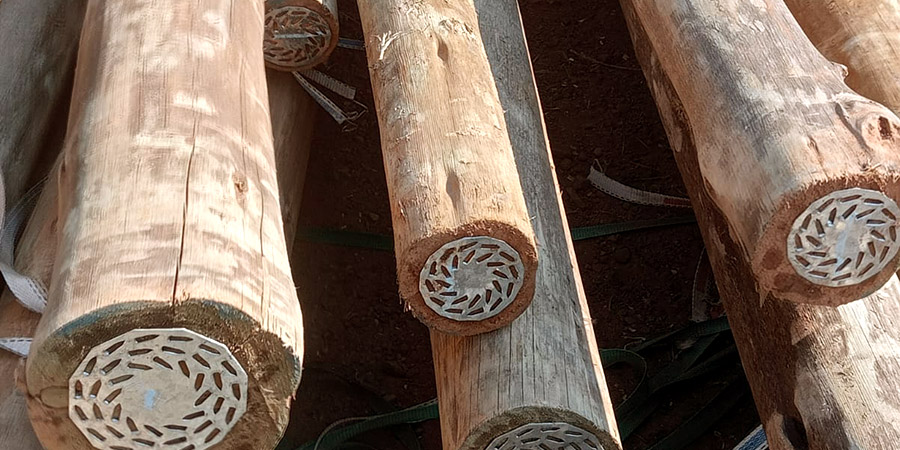
- Look for the SABS stamp. Properly certified poles carry an official mark. On our poles it appears on the anti-split plate fitted to each end.
- Ask about penetration depth. Surface coating is not treatment. Our CCA treatment penetrates at least 13mm into the timber, in line with SABS requirements. If a supplier cannot tell you their penetration depth, that is informative in itself.
- Ask which class, not whether it is treated. “Yes, it’s treated” is not an answer. “H4, to SANS 1288” is.
- Ask about inspection. Our poles are inspected regularly by SABS representatives, which is what keeps certification meaningful rather than nominal.
- Check the ends. Anti-split plates, sometimes called gangnails, reduce splitting as the pole dries and indicate a supplier who takes the product seriously.
Why H4 treated poles matter more in Durban
KwaZulu-Natal is close to a worst-case environment for untreated or under-treated timber. Humidity stays high for much of the year, summer rainfall is heavy, and termite pressure is significant. Add coastal salt air along the seaboard and the margin for error narrows further.
In a dry inland climate, under-specified timber may survive for years on luck. Here it will not. The same fence built to H3 in Gauteng and H3 in Durban will have very different lifespans, and neither should have been H3 if the poles are in the ground. This is also why correct installation, with proper post depth and drainage, matters alongside the treatment itself.
Common mistakes worth avoiding
- Cutting a treated pole and burying the cut end. Treatment is deepest at the surface. A fresh cut exposes less-protected timber, and cut ends going into the ground should be sealed.
- Assuming thicker means stronger for longer. Diameter affects load capacity. It does not compensate for the wrong treatment class.
- Mixing classes without thinking. Using H4 for posts and untreated timber for rails means the structure still fails, just somewhere else.
- Buying on price alone. The price gap between properly treated and marginally treated poles is small. The cost gap over ten years is not.
Matching H4 treated poles to the job
Treatment class is one half of the decision. Diameter is the other. Our poles are classified by the diameter measured at the top, or thinner, end:
- 20mm to 32mm – intengu laths, ideal for screening, in 3m and 3.6m lengths
- 32mm to 50mm – treated droppers, in lengths up to 2.4m
- 50mm to 75mm – lighter fencing and garden applications
- 75mm to 100mm – a common thickness for standard fencing poles
- 100mm to 125mm – heavier fencing and structural work
- 125mm to 150mm – structural and larger-scale applications
We stock these in lengths from 1.2m up to 7.2m. The full range, including current sizes and lengths, is on our treated poles for sale page, and our treated poles FAQs cover delivery, collection and payment.
If you are unsure, ask before you buy
Specification questions are easier to answer before an order than after a structure has been built. If you can describe the project, the ground conditions and how long you need it to last, working out the right class and diameter is usually straightforward.
All Durban Poles timber is CCA pressure-treated, SABS approved and treated to H4 as per SAWPA standards. Contact Durban Poles and we will talk through what your specific project needs.
Need treated timber poles?
We supply treated poles in a range of sizes for fencing, construction and landscaping across KwaZulu-Natal. All our timber is SABS and ISO 9001 approved.